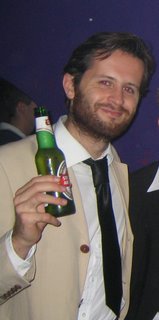
Duhamel writes editorials for newspaper, he is a journalist and a political
interviewer on RTL (the French radio with the largest audience) and on
France 2.
The basic story is: last November this journalist is invited to talk at a
small conference by some students (young members of Bayrou’s party the UDF)
at Sciences Po in Paris (the equivalent of the LSE for France some would
say). In the course of his speech he negligently mentions that he intends to
vote for Bayrou in the next presidential election. He claims not to have
known that the conference was being videotaped. At the beginning of
February, the students put the video on their website and on
dailymotion.com, a few blogs mention it, but no one seems to pay attention
to it. Yesterday morning, the video had only been seen 265 times. That’s
when Guy Birenbaum puts the video on his blog (he is a very complex figure,
he has a PhD in political science with a thesis on the Front National and is
officially a political science professor at a French University although he
doesn’t teach anymore, he created his own publishing company where he
publishes mainly essays that would not be accepted by other companies
because of their polemical content, he writes editorials for different
medias and polemical books, and has a blog with a wide audience). Soon the
information that Duhamel votes for Bayrou appears on the website of all the
big medias (le Figaro, le Monde, Libération…) and arguing that Duhamel now
lacks the independence needed to do his job he is suspended, first from
France 2 and then from RTL. He was actually scheduled to interview Bayrou on
France 2 yesterday evening. The whole thing started a big buzz about the
independence of journalists... and about the impact of
internet compared to traditional media.
Monday, February 19, 2007
The election will not be televised [not by Duhamel, that is]
Interesting story last week about Alain Duhamel, respected French television journalist who was sacked for revealing who he would vote for in the upcoming presidential election. Here's the story, as recounted by someone more familiar with the case than I [thanks Ben!]:


Wednesday, February 07, 2007
State funding of Italian parties
Recently, I've been looking at the system of state funding of Italian political parties. I'm interested in the subject because of the incentives it may create to form new parliamentary groups (since they qualify for funding), and the way funding systems interact with the new electoral system.
The history of state funding is pretty shabby. In 1993, an abrogative referendum repealed parts of the law on party funding, banning direct subventions, but allowing compensation for electoral expenses. These electoral expenses gradually grew; new laws were passed in 1999 and 2002, lowering the qualification threshold from 4% of vote-share to 1% of vote share (or electing at least one candidate), with funds divided according to the parties' vote-shares.
The history of state funding is pretty shabby. In 1993, an abrogative referendum repealed parts of the law on party funding, banning direct subventions, but allowing compensation for electoral expenses. These electoral expenses gradually grew; new laws were passed in 1999 and 2002, lowering the qualification threshold from 4% of vote-share to 1% of vote share (or electing at least one candidate), with funds divided according to the parties' vote-shares.
Wednesday, January 24, 2007
Monday, January 22, 2007
Observational equivalence
One of the measures of PSB independence I'm looking at is the turn-over rate of PSB directors-general, and specifically whether they often change within six months of a government change. The idea is that, if directors-general are appointed only for two years, or if they know they'll be fired with a government change, they can't be independent of politics.
So, if turnover is low,that means the broadcaster is independent, doesn't it? Not necessarily. Here's Mark Pollack explaining why the problem of observational equivalence messes things up:
So, if turnover is low,that means the broadcaster is independent, doesn't it? Not necessarily. Here's Mark Pollack explaining why the problem of observational equivalence messes things up:
Studies of agency autonomy that rely on the frequency of sanctioning are therefore likely to run into the methodological problem of observational equivalence, namely that the absence of sanctions is consistent with both the obedient servant and the runaway bureaucracy scenarios, each of which predicts, albeit for different reasons, the rarity of sanctions
Sunday, January 21, 2007
France 2, director of programmes sacked
[Thanks to Michael for the link] : Jean Baptiste Jouy sacked as director of programmes for France 2. Culture shock at moving from Canal+ a factor.
Saturday, January 20, 2007
Weekly round-up: BBC, RTVE, RAI
Three items this week, in descending order of importance, increasing order of triviality:
- The cost of a BBC licence fee was set for the next six years. The fee will increase 3% for the next two years, and 2% for the four following years. The figures roughly follow projections for CPI, but there is no inflation link. The BBC is annoyed, because they think the settlement is below RPI (which is below industry-specific inflation for broadcasting, which may be subject to Baumol's disease), and because they thought they would get extra for spearheading the switch to digital terrestrial. They do (a £200m side-payment), but the DCMS is sure that there are cost-savings to be made. [Historical data on licence fee]
- RTVE revealed its new executive line-up. According to Formula TV, Director-General Javier Pons has kept Fran Llorente and Pablo Carrasco as directors of News & Current Affairs and Content respectively, but Carrasco loses control over Programming, which goes to Carlos Fernandez. The RTVE union in Madrid opposes against Carrasco's nomination, claiming he favours external production far too much.
- RAI councillors complain when people criticise them. The five right-wing members of the Rai board - Urbani, Petroni, Bianchi Clerici, Malgieri, and Staderini - denounced the "campaign to delegitimate their action" - roughly, criticism that they acted in a partial manner damaging to the company when they appointed Alfredo Meocci as Director-General in violation of rules of conflict of interest. One interesting tid-bit: the CdA had wanted to give Siniscalco [Minister of Finance at the time, and thus sole shareholder] a list of names; Siniscalco refused and said he only wanted one. Good on 'im
Saturday, January 13, 2007
Dyke didn't jump but was pushed
Minutes of the BBC Governors' meeting of the 28th and 29th January reveal that Greg Dyke was sacked by the Board of Governors, rather than resigning. As Torin Douglas wrote,
For those who have read Greg Dyke's book Inside Story, there are few surprises in the minutes of the BBC governors' meetings.Still, nice to have it confirmed officially.
Subscribe to:
Posts (Atom)